Building AI-Ready Insurance Workflows with Connected Systems
Jun 11, 2026
Key Takeaways
- AI delivers the most value when built into connected, end-to-end insurance workflows.
- Unified data, intelligent automation, and accessible knowledge are the foundations of AI readiness.
- Connected systems reduce manual effort, improve decision-making, and accelerate operations.
- The future of insurance lies in intelligent ecosystems where AI, data, and workflows work together seamlessly.
AI Isn’t the Problem. Fragmented Workflows Are.
Insurance organizations are investing heavily in artificial intelligence. From underwriting assistants and intelligent document processing to claims automation and customer service bots, AI has quickly moved from experimentation to strategic priority.
Yet many insurers face a surprising reality.
Despite deploying AI tools, operational bottlenecks remain. Underwriters still spend hours gathering information. Claims teams continue navigating multiple systems. Employees search through countless documents to find answers. Data remains fragmented across policy systems, CRMs, spreadsheets, email inboxes, and third-party platforms.
The issue isn’t a lack of AI. It’s a lack of connected workflows.
AI performs best when it has access to accurate data, organizational knowledge, and clearly orchestrated processes. Without that foundation, even the most advanced AI models struggle to deliver meaningful business outcomes.
This is becoming increasingly important as insurers accelerate digital transformation efforts. McKinsey estimates that AI technologies could generate up to $1.1 trillion in annual value for the global insurance industry through improvements in underwriting, customer service, claims, and operational efficiency. But realizing that value requires more than deploying isolated AI tools—it requires redesigning how work flows across the enterprise.
The insurers seeing the greatest returns from AI are not simply adding intelligence to existing processes. They are building AI-ready workflows where systems, data, people, and knowledge operate as a connected ecosystem.
Why Traditional Insurance Workflows Limit AI Success
Most insurance organizations have accumulated technology over many years.
Policy administration systems, claims platforms, CRM tools, broker portals, document repositories, rating engines, and external data providers often operate independently, creating fragmented workflows.
This creates three common challenges:
- Disconnected Data
Critical information exists across multiple systems, making it difficult to establish a single source of truth.
- Manual Process Dependencies
Employees frequently spend time transferring information between systems, updating records, routing documents, and searching for supporting information.
- Institutional Knowledge Silos
Business expertise often resides in documents, emails, SOPs, and experienced employees rather than in structured, accessible systems.
As a result, AI spends more time looking for information than generating value.
For insurers, becoming AI-ready means solving these foundational workflow challenges first.
Building AI-Ready Insurance Workflows: The Five Essential Building Blocks
The most successful AI initiatives are built on connected operational foundations. Rather than treating AI as a standalone capability, insurers should focus on creating an environment where intelligence can flow naturally across the organization.
1. Connected Data Foundations
AI depends on context.
When policy administration systems, CRM platforms, claims systems, external data providers, and operational databases work together, AI gains a complete understanding of customers, risks, and business processes.
Instead of pulling information from multiple sources manually, teams can access a unified operational view. The result is faster decisions, better customer experiences, and greater confidence in AI-generated recommendations.
2. Intelligent Document Processing
Insurance remains one of the most document-intensive industries.
Submissions, applications, ACORD forms, endorsements, inspection reports, policy documents, and claims files contain valuable business information.
Modern AI-powered document intelligence transforms these documents into structured data automatically. Rather than manually extracting information, insurers can instantly capture, classify, validate, and distribute critical data throughout downstream workflows.
Documents stop being bottlenecks and become decision accelerators.
3. Workflow Automation That Drives Outcomes
Many organizations automate individual tasks. AI-ready organizations automate business outcomes.
For example, a new submission can trigger multiple actions automatically:
- Data extraction
- Risk enrichment
- Classification
- Underwriter assignment
- CRM updates
- Internal notifications
- Reporting updates
The workflow becomes a connected operational process rather than a series of disconnected activities.
4. AI-Powered Knowledge Systems
One of the most overlooked assets in insurance is institutional knowledge.
Underwriting guidelines, policy rules, claims procedures, compliance documentation, training materials, and operational playbooks are often scattered across hundreds of files and systems. This creates friction for employees and limits AI effectiveness.
AI-ready insurers are increasingly building centralized knowledge systems that consolidate organizational expertise into searchable, continuously accessible intelligence.
Instead of searching through documents or escalating questions, employees can retrieve answers instantly using natural language. At the same time, AI systems gain access to the business context necessary for making accurate recommendations.
This capability becomes increasingly important as experienced insurance professionals retire, and organizations seek to preserve institutional expertise.
5. Operational Visibility and Intelligence
Connected workflows generate continuous operational insights. Leaders gain visibility into:
- Submission volumes
- Workflow bottlenecks
- Underwriting workloads
- Service performance
- Claims processing timelines
- Customer engagement metrics
Rather than relying on periodic reporting, insurers can make decisions based on real-time operational intelligence.
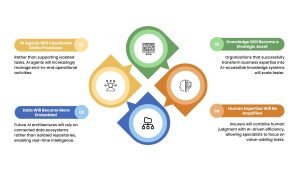
Top 4 Trends Shaping the Future of AI-Ready Insurance Operations
As insurers move beyond isolated AI initiatives, several emerging trends are redefining how intelligent, connected insurance operations will function in the years ahead. Here are the top four:
To Wrap Up
The conversation around AI in insurance is evolving.
The question is no longer whether insurers should adopt AI. Most already have.
The real question is whether their workflows are prepared to support it.
AI cannot create transformational value inside fragmented operational environments. It requires connected data, accessible knowledge, intelligent automation, and integrated systems working together.
The insurers that will lead the next decade are not those deploying the most AI tools. They are the ones building connected ecosystems where information moves seamlessly, expertise is instantly accessible, and intelligent workflows continuously improve how business gets done.
Ready to build AI-ready insurance workflows that drive measurable business outcomes? Get in touch with KMG to discover how connected systems, intelligent automation, and AI-powered solutions can help transform your operations.