Data Lakehouse for Modern Insurance Teams: A Foundation for Analytics, AI, and Operational Excellence
Jun 19, 2026
The Insurance Industry’s Growing Data Challenge
Insurance organizations generate and consume vast amounts of data across underwriting, claims, policy administration, finance, compliance, and customer operations. In addition, insurers increasingly rely on information from brokers, MGAs, third-party providers, telematics platforms, and digital customer channels.
While data volumes continue to grow, many organizations still struggle with:
- Fragmented systems
- Inconsistent data quality
- Manual reporting processes
- Limited visibility across business operations
Valuable information often remains trapped in multiple systems, making it difficult to gain timely insights and respond quickly to changing market conditions. In fact, 39% of insurers identify fragmented data environments as a major barrier to innovation and AI adoption, highlighting the growing need for a more connected and accessible data ecosystem.
As insurers continue to modernize their operations and invest in advanced analytics, establishing a scalable and unified data foundation has become a critical business priority.
Data Lakehouse: A Modern Foundation for Insurance Data
To overcome the challenges of fragmented systems, inconsistent data quality, and growing analytical demands, many insurers are adopting data lakehouse architectures.
A data lakehouse provides a unified foundation for storing, managing, and analyzing data across the organization. By bringing together structured, semi-structured, and unstructured data within a single environment, insurers can improve data accessibility, streamline reporting, and support more informed decision-making.
Rather than relying on multiple disconnected platforms for storage, analytics, and AI initiatives, insurance teams can leverage a centralized architecture that supports operational efficiency, advanced analytics, and future innovation.
Business Outcomes Enabled by a Data Lakehouse
For insurance organizations, a data lakehouse is not simply a modernization initiative; it is an enterprise data strategy that enables greater agility, operational resilience, and long-term competitive advantage. Key business outcomes include:
Enterprise-Wide Visibility Across the Insurance Value Chain
Enables insurers to unify data across underwriting, claims, policy administration, finance, distribution, customer service, and third-party ecosystems. This creates a consistent view of business performance, allowing teams to identify trends, evaluate operational effectiveness, and make decisions based on a shared source of truth rather than fragmented departmental reports.
Faster Response to Market and Portfolio Changes
Assess portfolio performance more rapidly, identify emerging risks, and refine underwriting, pricing, and operational strategies with greater confidence through large-scale data consolidation and analysis. In an environment shaped by economic uncertainty, catastrophic losses, regulatory complexity, and evolving customer expectations, a data lakehouse provides the visibility needed to support faster, more informed decision-making across the enterprise.
Reduced Time-to-Insight for Strategic Decision-Making
Reduces dependency on manual data preparation and reconciliation across multiple systems, enabling business leaders to accelerate the transition from data collection to decision-making while improving the speed, accuracy, and reliability of insights.
Improved Operational Efficiency Through Data Standardization
Establishes a standardized and scalable data foundation that reduces operational complexity, improves data consistency, and minimizes the overhead associated with disconnected systems, duplicate datasets, and siloed reporting environments.
Accelerated Integration Across Acquisitions and Business Units
Provides a scalable foundation for integrating acquisitions, helping insurers overcome the complexities of disparate systems and data silos. This supports faster operational integration, accelerates the realization of synergies, and ensures consistent data governance across the enterprise.
AI and Innovation Readiness at Scale
Enables the successful adoption of AI by providing access to trusted, high-quality, and accessible data—the foundation upon which machine learning, predictive analytics, intelligent automation, and generative AI initiatives depend. Rather than deploying isolated use cases, insurers can create a scalable environment that supports enterprise-wide innovation and long-term AI transformation.
Greater Value from Existing Technology Investments
Helps maximize the value of existing technology investments by enabling seamless data interoperability across policy administration systems, claims platforms, CRM solutions, and third-party data sources. This reduces information silos and creates a connected data ecosystem that supports both operational efficiency and advanced analytics.
Key Requirements for Operationalizing a Data Lakehouse
While implementing a data lakehouse is an important step, realizing long-term business value requires more than technology deployment. Successful initiatives are typically supported by a combination of strategy, operating model, and organizational alignment that enables data to become a business asset rather than simply an IT capability. Key requirements include:
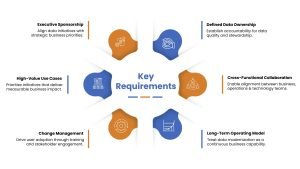
While these requirements establish the foundation for a successful Data Lakehouse strategy, selecting the right platform is equally important to ensuring long-term scalability, adoption, and business value.
Why Databricks is Emerging as the Lakehouse Platform of Choice for Insurers
Databricks is helping insurers accelerate their data and AI transformation by providing a unified platform for data engineering, analytics, and AI on a secure cloud-based Lakehouse architecture.
Leveraging deep data engineering expertise and extensive insurance domain knowledge, KMG helps insurers modernize their data platforms and operationalize analytics and AI on Databricks. From data integration and platform modernization to analytics enablement and AI adoption, KMG supports insurers in transforming data into a strategic business asset.
The Foundation for the Future of Insurance
As the insurance industry continues to evolve, the ability to adapt, innovate, and create value from data will increasingly differentiate market leaders from their competitors. Organizations that invest in modern data foundations today will be better positioned to navigate future challenges, capitalize on emerging opportunities, and build a more agile, intelligent, and resilient enterprise.
Looking to build a future-ready data foundation for your organization? Connect with KMG to discuss your Data Lakehouse and AI transformation journey.